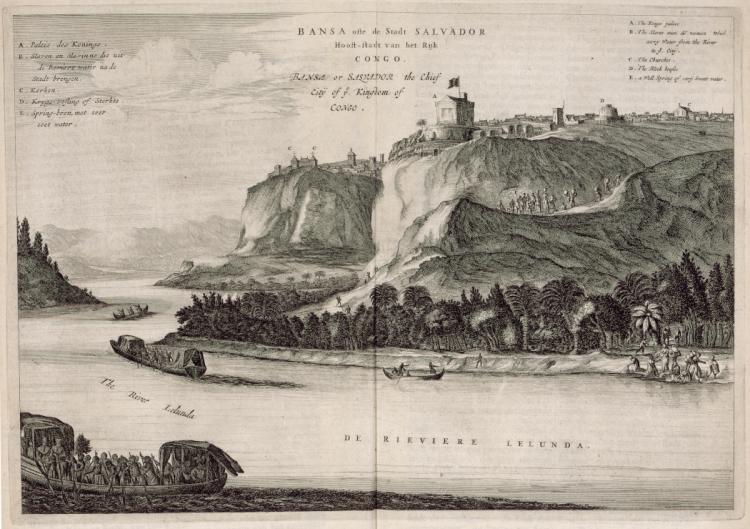
History · Heritage · Civilisation · Engraving, 1668
A Kingdom That
Image: Mbanza Kongo (São Salvador). Engraving. From O[Ifert] Dapper, Naukeurige beschrijvinge der Afrikaensche gewesten, 1668, p. 562-63.
The Kingdom of Kongo was one of the most powerful, sophisticated, and diplomatically active states in the pre-colonial world — and its legacy lives in the cultures, spirituality, and music of hundreds of millions across Africa, Europe and the Americas today.
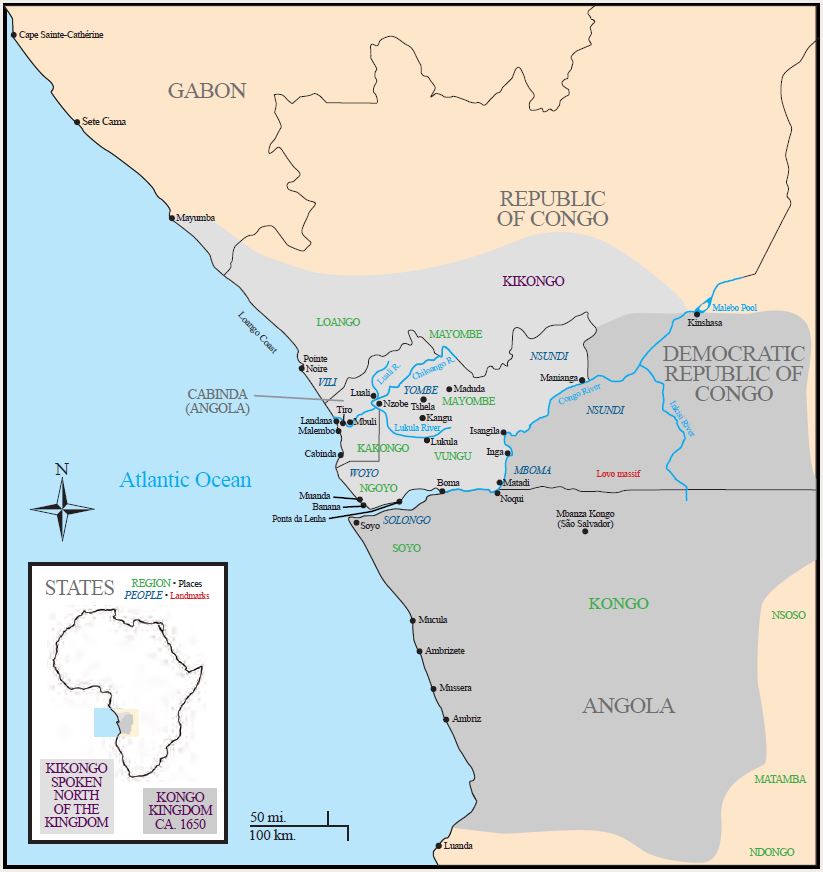
Founded in the late 14th century on the south bank of the Congo River, the Kingdom of Kongo — Kongo dia Ntotila — grew into one of the most significant polities in sub-Saharan Africa. At its height it encompassed territory spanning modern-day western DRC, northern Angola, Republic of Congo, and Gabon — a state of several million people with sophisticated administration, professional armies, taxation systems, and diplomatic offices that communicated with foreign courts as equals.
The Manikongo — the king — held authority derived from an intricate system of spiritual legitimacy and popular consent. The kingdom was not a collection of tribes but a centralised monarchy with a structured nobility, professional trade networks, and a capital at Mbanza Kongo that rivalled European cities of its time in complexity and governance.
In 1483, Portuguese explorers reached the Kingdom of Kongo — and were received not as conquerors but as potential partners. What followed was one of the most remarkable diplomatic exchanges of the Renaissance. The Manikongo sent ambassadors to Lisbon. Kongolese princes studied in Portugal. In 1506, Afonso I — one of the most extraordinary rulers of the 16th century — became Manikongo and began an astonishing correspondence with the Kings of Portugal and with Rome.
Afonso I's letters, preserved in Portuguese and Vatican archives, are among the most eloquent diplomatic documents of the age — written in perfect Portuguese, citing scripture, invoking moral authority, demanding the end of the slave trade, and asserting the full sovereignty of his kingdom. In 1518, his son Henrique was ordained in Rome as the first sub-Saharan African bishop by Pope Leo X. Kongolese ambassadors were received across Europe throughout the 16th century.
"There are many of our subjects hungry for the merchandise of your Kingdoms... in order to satisfy their voracious appetite, they seize many of our people... We beg you to agree that this cannot be, since otherwise we cannot remedy such an obvious damage." — Afonso I, King of Kongo, to King João III of Portugal, 1526
Kongolese civilisation produced one of the most sophisticated cosmological systems in the pre-modern world. The Dikenga dia Kongo — the Kongo cosmogram — encodes an entire philosophy of existence: the cycle of birth (Kala), peak of life (Tukula), transformation through death (Luvemba), and ancestral rebirth (Musoni). The horizontal axis divides the world of the living from the realm of the ancestors. The vertical axis maps the path of the individual soul.
This symbol was not decorative. It was drawn at rituals, woven into textiles, carved into sacred objects, inscribed on the bodies of initiates. CAF Foundation carries it in its visual identity as a declaration that Kongolese philosophy is not history — it is a living framework for understanding the world.
The Kongo Kingdom's most painful and most enduring impact on world history came through the Atlantic slave trade. Between the 16th and 19th centuries, hundreds of thousands of Kongolese people were enslaved and transported to the Americas. They carried with them the Dikenga, Kongolese spiritual practice, musical traditions, and philosophical frameworks — which did not disappear but adapted, merged, survived, and flourished.
Afro-Brazilian Candomblé preserves direct Kongolese religious elements. Cuban Palo Monte carries Kongolese cosmology at its core. Haitian Vodou, the ring shout of African-American sacred music, the Jonkonnu festivals of Jamaica, the capoeira of Brazil — all carry traces of the Kingdom of Kongo. The word "zombie" derives from the Kikongo nzambi, spirit of the dead. This kingdom scattered across an ocean and seeded new civilisations. Its descendants live on every continent.
The formal political kingdom ended under Belgian colonialism — but the Kongo people did not. Kongo-Central province remains home to millions of descendants, governed partly by traditional royal families who trace direct lineage to the ancient monarchs of Mbanza Kongo. In 2021, UNESCO inscribed Congolese Rumba — which carries Kongo musical DNA at its root — as Intangible Cultural Heritage of Humanity. The Kingdom of Kongo is not history. It is the present.
CAF Foundation's Culture & Heritage programme preserves and shares Congolese history with diaspora communities and with the world. Your support makes this possible.
Donate →